Nutrition misinformation does not win because it is better.
It wins because it is easier to understand, easier to repeat, and usually much more emotionally satisfying.
It’s not that I think every dietitian needs to start yelling into a ring light about cortisol cocktails. Please don’t.
But qualified experts have a communication problem, and pretending otherwise is not helping anyone. Bad health information is built to travel. It is simple. It is confident. It gives people a villain, a sense of urgency, and a clear next step.
Avoid this food.
Take this supplement.
Your provider is outdated.
This one study proves it.
Your symptoms are actually caused by this one thing nobody told you about.
It is clean. It is clickable. It gives people the relief of feeling like they finally know what to do.
Meanwhile, qualified clinicians are trained to be careful. We are taught to consider the full picture, look at the evidence, think about scope, account for medical history and individuality, and avoid making claims we cannot defend. This is how it should be.
But online, careful can sound vague or hesitant. It can sound like we are dodging the question.
When the evidence-based answer is buried under seven caveats while the grifter gives a five-second “fix,” we should not be surprised when the grifter gets more attention.
This is not just a wellness culture problem. It is not just a social media problem. And it is definitely not solved by rolling our eyes and assuming people should know better.
We cannot keep communicating nutrition science as if the most accurate person in the room will automatically be the most trusted.
That is not how humans work.
And to be clear, while I am writing from the perspective of a dietitian, this is not a problem limited to nutrition. Anyone communicating health information has to consider whether they are making the accurate answer easier or harder to hear.
Table of Contents
The problem is not nuance. The problem is poorly packaged nuance.
I do not think the answer is to keep repeating that nutrition is nuanced, as if that alone is a useful answer. Most people already know health is complicated. And we have already tried this in a lot of ways:
“It depends.”
“The research is mixed.”
“More research is needed.”
“This is multifactorial.”
“We can’t say for sure.”
All of those statements can be true. They are also wildly unsatisfying when they are the whole answer.
This is where I think we sometimes get stuck. We are trying to be accurate, ethical, and careful, which matters. But if our explanation leaves the person more confused than when they started, we have not really communicated the science. We have just protected ourselves from being wrong.
So yes, it depends. But what does it depend on? That is the part we need to get better at explaining.
A weak answer: “It depends.”
A better answer: “It depends on the dose, the person’s baseline intake, their medical history, medications, symptoms, access, and what they can realistically do with the information.”
A stronger public-facing answer: “Most people do not need to panic about this. Here are the three situations where I would pay closer attention.”
That last version does not erase nuance. It organizes it. People can handle nuance when it is clear and connected to a real decision. What they struggle with is nuance that feels like fog.
Asserting nuance should not make us sound like we have no clue what the hell is going on.
It should help people understand what we know and do not know, who the information applies to, and what the next reasonable step might be.
We may have oversimplified science education too far
Part of this problem is that some of our messaging became so broad it stopped being useful. As weight-inclusive and more equitable approaches became more visible, many of us changed how we talked about food. We were trying to move people away from shame-based rules and moralized eating.
Good. I am not interested in going backward on that.
But there is a difference between reducing harm and removing all context.
“All foods fit.” “There are no bad foods.” “Focus on balance.” “It depends.” These statements can be true and still leave people with nothing to do. Without context, they start to sound like we are saying nothing at all.
We’ve Seen This Play Out Before
“Drink more water” → more is always better → people forcing fluids past what their body can safely handle.
“Reduce dietary cholesterol” → avoid eggs → wait, that changed? → cholesterol must not matter → butter coffee and carnivore logic.
“Eat what you want” + “no bad foods” → dietitians are telling people to live on pizza and ice cream. No. That is not what that means. Please unclench.
“Nutrition can affect mood” → the right diet can cure depression, ADHD, or severe mental illness.
“Some supplements may help in specific situations” → the right probiotic strain or magnesium form will fix everything.
When we leave out too much context, we create the perfect setup for someone with ill intent to walk into that gap. People feel like the advice keeps changing, like experts never give a straight answer, like they cannot tell who is legit. And then someone with a tiny study, a dramatic claim, and a very confident face offers them certainty.
Why clickbait sounds more convincing than it deserves to
A fear-based reel does not need to be accurate. It just needs to feel clear enough, urgent enough, and emotionally charged enough to make someone stop scrolling.
Misinformation often gives people exactly what careful communication avoids: a villain, a sense of urgency, and a clear next step. Buy this, avoid that, test this, heal that. When someone is exhausted, symptomatic, and struggling to function through a normal Tuesday, “this is complex and multifactorial” may be true, but it is not satisfying.
“It’s actually this one food” feels like relief. It lowers the mental workload.
That does not mean people are gullible. Bad information is often built around real human needs: answers, control, an explanation for why they feel terrible.
“Root cause” language is a good example. I am not against asking why something is happening; that is a useful clinical question.
But online, “root cause” usually becomes a marketing hook that implies every symptom has one hidden source, every provider missed it, and every person just needs the right protocol to fix themselves. It is powerful because it feels tidy. Bodies are not usually that tidy. Mental health is definitely not that tidy.
The part worth paying attention to is not the fear or the overclaims. It is the clarity. People are drawn to messages that help them understand what matters and what to do next. That is a communication problem, and it is one we actually have some control over.
We need to communicate like translators, not human abstracts
This is where I think clinicians have an important role to play. We are not just information distributors, and most people do not need us to recite the abstract, list every limitation, and then leave them standing there with a pile of technically accurate facts they do not know how to use.
They need help interpreting what the information means.
Does this apply to me?
How strong is the evidence?
What does this actually tell us?
What would be a reasonable next step?
And honestly, what can we ignore for now?
That last question matters more than we give it credit for. Part of good science communication is helping people decide what does not deserve their immediate attention.
Not every new study is groundbreaking and client-ready. Just like not every nutrition trend deserves a full emotional spiral and a 17-tab research rabbit hole. I say this as someone who has absolutely opened the 17 tabs.
This is where research-to-practice translation and then good science communication matter.
Our job is not to make every client, patient, or social media reader fluent in nutrition science.
Our job is to translate the science well enough that people can make better decisions. That means we have to do more than say, “The research is mixed.”
We have to explain what kind of mixed.
Mixed because the studies are small?
Mixed because the populations are different?
Mixed because the outcome measured is not actually the outcome people are claiming online?
Mixed because the mechanism is interesting, but the clinical application is not there yet?
Those distinctions matter even more in nutrition and behavioral health, where a claim can quickly drift from “this may support mood” into “this will treat depression,” or from “gut health may be relevant” into “your anxiety is actually a probiotic deficiency.”
And then we are no longer just dealing with a messy interpretation of science.
We are dealing with supplement overpromising, food fear, shame, scope issues, distrust of medication or therapy, and unrealistic “root cause” protocols that ask people to go bankrupt or build their entire life around fixing themselves.
As clinicians, we have to be able to say:
“This is promising, but not something I would build a whole care plan around.”
“This may be worth assessing, but it is not the first place I would start.”
“This mechanism is interesting, but the recommendation being made from it is moving too fast.”
“This could matter for some clients, but not in the way this post is claiming.”
This translation role may look different depending on the clinician.
For a dietitian, it might mean turning a study into a nutrition assessment, a realistic food-related intervention, or a scope-safe explanation of why nutrition may matter.
For a therapist, it might mean helping a client slow down before they turn a social media claim into another rule, another shame spiral, or another reason to distrust their body.
For a physician, NP, nurse, or pharmacist, it might mean recognizing when a nutrition claim is influencing medication decisions, supplement use, lab requests, or treatment adherence.
None of that requires every clinician to become an expert on every health or science-related topic. But it does require us to recognize when health misinformation is shaping the story a person is telling about their body, their symptoms, or their care.
And I think that is the skill we need to keep building. Better science communication is not just a content skill; it is a clinical skill.
Because the way we explain evidence shapes what people believe is safe, realistic, and worth trying.
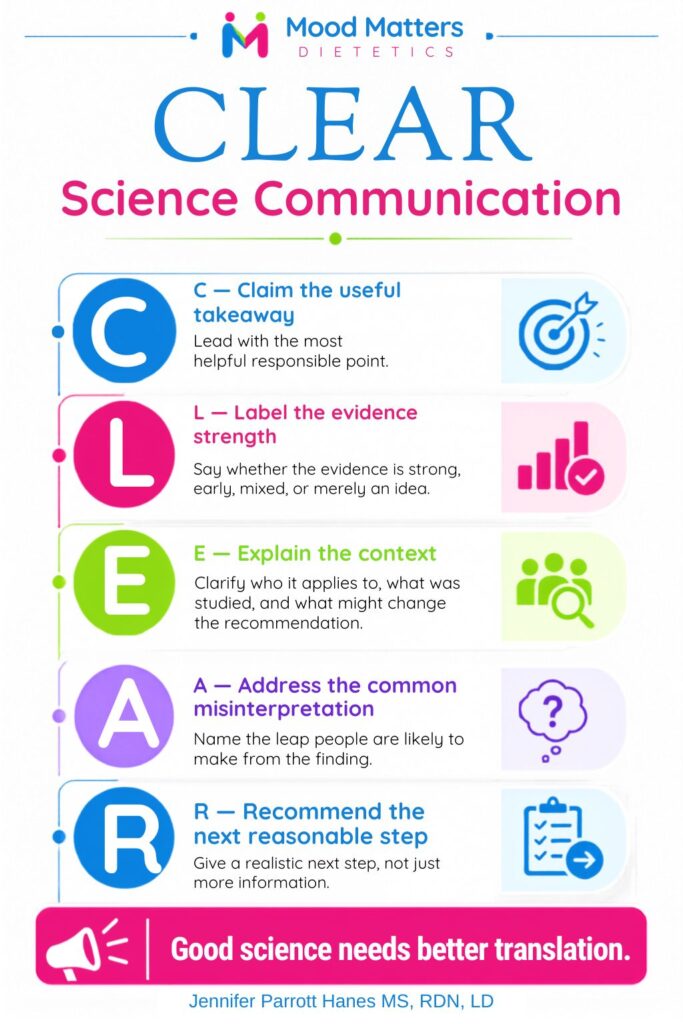
A proposed framework: CLEAR science communication
So what does better science communication actually look like?
I think it helps to have a simple framework. Not that every post, article, conversation, or client explanation needs to follow a formula exactly. That would get annoying quickly. But a framework gives us something to check against.
When I’m trying to explain nutrition science clearly, especially in areas where the evidence is nuanced or easy to overstate, I want the message to do five things.
I want it to state the useful takeaway, label the strength of the evidence, explain the context, address common misinterpretations, and recommend the next reasonable step.
That gives us CLEAR science communication.
C — Claim the useful takeaway
Start with the most helpful responsible point.
This is where we often lose people. We give so much background before naming the takeaway that the reader has to work too hard to figure out what we are actually saying.
The useful takeaway should not be exaggerated. It should not be more confident than the evidence allows. But it should exist.
The SMILES trial, a 2017 randomized controlled trial examining whether dietary intervention could improve depressive symptoms, gives us a useful example:
“Diet cures depression.”
That is too broad, too confident, and too easy to misuse.
A clearer version would be:
“The SMILES trial gives us reason to take diet quality seriously in depression care. In that study, a dietitian-led Mediterranean-style dietary intervention improved depressive symptoms more than social support over 12 weeks.”
L — Label the evidence strength
People need to know how much confidence the claim deserves.
We can say things like:
“This is well-supported.”
“This is promising but early.”
“This is mechanistically interesting, but not practice-changing yet.”
“This has evidence in specific populations.”
“This is not supported enough to recommend as the first step.”
That kind of language helps people understand the difference between a solid recommendation, an emerging idea, and a claim that is sprinting ahead of the evidence.
For the SMILES trial, we might say, the study was “promising and clinically relevant, but it was still one trial with a modest sample size. Not proof for a universal protocol.”
E — Explain the context
Context is where nuance becomes useful. This is where we clarify who the information applies to and what details might change the recommendation.
A few questions I like to think through:
Who was studied? Was this in humans?
Was this in adults, children, or a specific clinical population?
Was the outcome actually meaningful?
Was the research examining a food, extract, supplement, lab value, mechanism, behavior, or a full intervention?
Does this change when we consider medications, trauma history, ADHD, food access, eating disorder history, or low capacity?
That last set matters a lot in nutrition and behavioral health.
A recommendation that looks reasonable in a controlled study may be completely unrealistic for a client who is depressed, underfed, working two jobs, managing stimulant appetite suppression, won’t get free food delivered to their door, or are trying not to relapse into rigid food rules.
Context does not make the message weaker, but it can make the message safer and more useful.
In the SMILES trial, the context is that the study looked at “adults with moderate to severe depression, involved dietitian-led nutrition intervention over 12 weeks, adjunctive to usual care.”
A — Address the common misinterpretation
This is one of the biggest missing pieces in public science communication.
It is not enough to explain what the study found. We also need to name the leap people are likely to make from it.
For example:
“This study shows an association. It does not prove that changing this one thing will treat the condition.”
Or:
“This mechanism matters, but the post is turning it into a recommendation faster than the evidence supports.”
Or:
“This may be relevant. It is not the whole treatment plan.”
This is especially important when we are talking about nutrition and mental health.
A study on inflammation and depression does not mean an anti-inflammatory diet treats depression.
A study on the gut-brain axis does not mean every client with anxiety needs a probiotic.
A study on omega-3s does not mean fish oil replaces medication, therapy, sleep support, safety planning, or actual clinical care.
We have to correct the leap, not just repeat the finding.
For example, the SMILES Trial “does not prove that diet alone treats depression or that people can eat their way out of mental illness.”
R — Recommend the next reasonable step
This is where the message becomes actionable. After someone reads the post, hears the explanation, or brings the question into session, what should happen next?
Sometimes the next step is simple:
Eat more vegetables.
Avoid foods that interfere with sleep (such as heartburn triggers).
Find physical activity you enjoy.
Spend time outdoors.
Spend time with people who support you
Sometimes the next step is actually to do less.
Don’t spend all your money at the supplement shop.
Do not try to overhaul your diet in one weekend.
Do not start drinking wine because that one study, or that one diet, says it’s good for you.
People do not need every detail of the study in one post or one client conversation. They need the clinically useful signal, the boundaries, and the next reasonable step. That is the difference between information and translation.
For dietitians, the SMILES Trial tells us to “assess meal patterns, diet quality, food access, appetite, energy, meds, and capacity. Then decide whether improving diet quality is a realistic first step or something to build toward.”
What this looks like in practice
Example 1: Gut-brain axis
Weak version:
The gut-brain axis is complex, and more research is needed.
Better version:
The gut and brain communicate, and GI symptoms can absolutely affect mood, anxiety, appetite, and daily functioning. What we cannot do is jump from that to “this probiotic treats depression.” Furthermore, not everyone tolerates probiotic supplements well.
I’d start with regular intake, monitoring GI symptom patterns (fiber tolerance, medications, stress load), increasing the amount and variety of fibers that you do tolerate, and referral when symptoms need medical evaluation.
Example 2: Supplements for mood
Weak version:
Supplements may help, but talk to your doctor.
Better version:
Some supplements have evidence in specific situations, but they are not automatically the foundation of mental health nutrition care. I’d want to know labs, medications, diagnoses, food intake, safety concerns, and what problem we are actually trying to solve before recommending anything.
Example 3: “Food is medicine”
Sorry AND, I staunchly oppose this messaging. It reads more pro-MAHA than real science. And it implies that the use/need for medication is because the individual didn’t “do enough” with food; it places the blame solely on the individual in front of us, ignoring social determinants of health, genetics, trauma history, and more. Also, no matter what anyone says, you can’t overcome some things with diet.
Weak version:
Food is not medicine.
Better version:
Nutrition can support mental health care. Good nutrition can manage medication side effects, help you process therapy, or sometimes even help your medication work better. But it does not replace therapy, medication, crisis support, or medical treatment. I use nutrition as one part of the support system, not as a standalone “cure.”
Why this matters in nutrition and mental health
This matters everywhere in health communication, but I think it gets especially messy in nutrition and in behavioral health.
Clients are not just asking, “Is this food good or bad?” They are asking whether their anxiety is actually their gut. Whether their ADHD is a dopamine problem they can eat their way out of.
Whether a supplement can replace medication. Whether glucose spikes are the emergencies carnivore bros make them out to be.
Whether their medication is “depleting” them. Whether they need to cut out half their diet to finally get to the “root cause.”
Whether their body is broken because a reel told them their cortisol is ruining everything.
That is a very different conversation from basic nutrition education. And when someone brings those questions into session, we have a choice in how we respond.
We can mock the claim, which may feel satisfying for about three seconds, but usually does not help the person sitting in front of us.
We can overcorrect and accidentally imply that nutrition does not really matter, which is also not true.
Or we can slow down, sort out the claim, and give them a sturdier way to think about it.
Because, in general, a client isn’t asking about a cortisol drink because they deeply care about the beverage. They are likely asking because they are exhausted, wired, sleeping poorly, and trying to figure out why their body feels unpredictable.
They are not asking about dopamine hacks because they think TikTok is the gold standard of neuroscience research.
And they likely don’t want to take a probiotic because they believe one capsule will fix their entire life.
We need to be able to say, “I can see why that sounds compelling, but could you also consider XYZ?”
We need to be able to say, “Nutrition can support mental health care, but it does not replace therapy, medication, safety planning, or medical treatment.”
We need to be able to say, “This might be worth exploring, but we may get quicker (or better) results starting with something more concrete.”
We need to be able to say, “Before we jump to supplements, I want to understand your intake, appetite, sleep, medications, labs, symptoms, and what you can realistically do right now.”
That kind of response protects more than accuracy. It protects trust. It keeps the client from feeling foolish for asking. It keeps us from reinforcing shame. It keeps nutrition in its rightful place: meaningful, sometimes powerful, but not magical.
In mental health nutrition, poor communication can cause real damage. It can make people afraid of food. It can make them blame themselves for symptoms they did not cause. It can make them distrust medication or therapy. It can push them toward rigid protocols that are expensive, exhausting, and nearly impossible to sustain.
Final Thoughts
I do not think the answer is for dietitians and other clinicians to become louder versions of the people we are worried about.
I do not want us to borrow the fear, the overclaims, the false certainty, or the “your provider is hiding this from you” nonsense. We have enough of that already.
But I do think we have to become better communicators; clear, direct, and practical.
We can say, “This is what we know,” “This is what we do not know yet,” and “This is what I would do with that information in real life.”
We can correct misinformation without mocking the person who believed it. We can explain nuance without burying people in caveats. We can make evidence-based communication clear enough to be useful and careful enough to be ethical.
Because if we leave a communication gap, someone else, less qualified but louder, will fill it.
I’d love to hear how other clinicians are thinking about this.
Where do you feel the tension most: being clear, staying nuanced, correcting misinformation, or trying not to sound like you’re arguing with the internet for a living? Comment below, or shoot me a message on LinkedIn.